


Mission creep or how the scope got scoped:
BACKGROUND:
The MBUG collection on the famous Walnut Creek CD-ROM is a massive library of public domain software compiled by the Melbourne Microbee Users Group. In the early 1990s, the collection of 186 curated disks were compressed into .ARC files and sent to the USA. Walnut Creek included it on their definitive CP/M archive disc in November 1994, making it a cornerstone of vintage software preservation.
The collection includes thousands of community-driven files, featuring: Australian Locally written system utilities and text tools, early text adventure games, such as Bunyip Adventure and a great version of Hitchhikers Guide to the Galaxy ,programming language disassemblers and custom terminal software. Walnut Creek excluded four specific disks— 46, 57, 129, & 137— from the CD-ROM, censored due to adult content hidden in certain text and ASCII art files. And of particular interest to moi, 1199 BASIC programs revealing many hints and programming techniques.
Decades later, thanks to animal & Chickenman the missing disks were added see: Repository Additions Microbee enthusiasts can access the full Walnut Creek ISO images on the Internet Archive and other sites.
TODAY:
My interest for the SQL exercise was a definitive index of the .mwb files served up on the internet. Everything progressed well until Sunday evening when I thought what if I could create a web page that not only included the names and descriptions but also served up individual program files bypassing the tedious find what disk its on, locate disk, extract file process. Modern security restrictions prevent such a web page being served up on the internet without extra layers of C# wrapping it. I wanted simple. So whynot a html file downloaded to the users own computer / phone /tablet (we need an android microbee simulator, anyone?).
I spend a lot of time driving between clients so yesterday morning I brainstormed, talking with geminiAI on Androuid Auto for 1.5 hours and at lunchtime got Claude to create the the file. Of course its a complex html file integrating 64-bit BLOBS to hold the 1199 .mwb files and it did not work. The display came up but did not populate with file names. So I uploaded it to Grok and grok solved the html coding issue in less than 1 minute.
Of course I had got ahead of myself and overwrote some of the file descriptions that I had worked on earlier so I had to revisit some files.
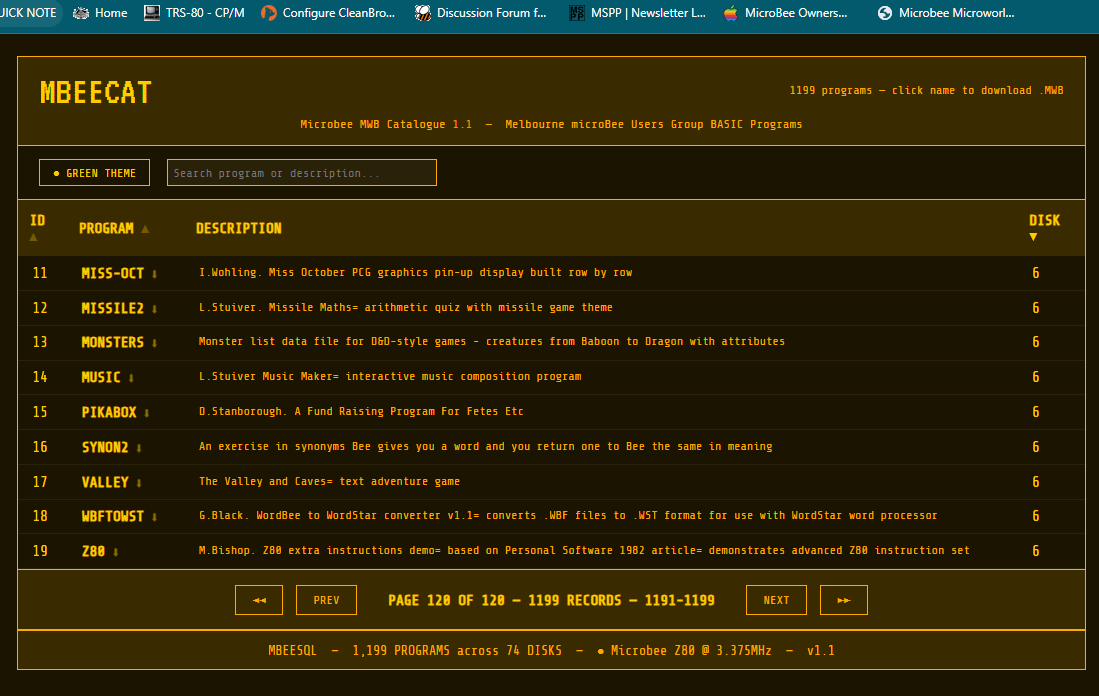
Anyway its finished! Instant search facility across names and descriptions, amber or green theme, sort by ID, name or original disk.
If there is any interest maybe it can be added to the Repository?
FULL circle I asked Gemini AI to descibe the html file:
The file **MBEECAT.HTML** is a self-contained, interactive utility titled **"MBEECAT — Microbee Catalogue 1.1"**. It acts as a specialized software management and file extractor interface designed specifically for legacy **Microbee systems**.
### Key Features and Architecture:
1. **Retro Aesthetic Styling:** The interface features a stylized retro "CRT display reveal" animation upon loading, using custom retro fonts (`Share Tech Mono` and `VT323`) and a classic "amber-on-dark" color palette (`--amber`, `--dim`, `--dark`, `--bg`).
2. **Embedded JavaScript Database and Library Integration:**
* It includes a search filter box allowing users to query a large dataset of classic Microbee programs, disk images, and files.
* It loads the standard `JSZip` library asynchronously via CDN.
* Crucially, the entire underlying archive of Microbee files is stored directly within the single HTML file as an encoded base64 block (`id="zipData"`), making the tool fully offline-functional.
3. **Targeted Extractor Functionality (`getMWB`):**
* The page handles files specifically with the `.MWB` extension, which represents **Microbee BASIC** program files.
* When a user selects a program from the catalog table, the internal function calculates paths formatted for classic Microbee User Group disk structures (e.g., `mbug001/PROGRAM.MWB`).
* It programmatically unzips the targeted file out of the cached archive in the browser and triggers an automatic browser download as an octet-stream binary.

BACKGROUND:
The MBUG collection on the famous Walnut Creek CD-ROM is a massive library of public domain software compiled by the Melbourne Microbee Users Group. In the early 1990s, the collection of 186 curated disks were compressed into .ARC files and sent to the USA. Walnut Creek included it on their definitive CP/M archive disc in November 1994, making it a cornerstone of vintage software preservation.
The collection includes thousands of community-driven files, featuring: Australian Locally written system utilities and text tools, early text adventure games, such as Bunyip Adventure and a great version of Hitchhikers Guide to the Galaxy ,programming language disassemblers and custom terminal software. Walnut Creek excluded four specific disks— 46, 57, 129, & 137— from the CD-ROM, censored due to adult content hidden in certain text and ASCII art files. And of particular interest to moi, 1199 BASIC programs revealing many hints and programming techniques.
Decades later, thanks to animal & Chickenman the missing disks were added see: Repository Additions Microbee enthusiasts can access the full Walnut Creek ISO images on the Internet Archive and other sites.
TODAY:
My interest for the SQL exercise was a definitive index of the .mwb files served up on the internet. Everything progressed well until Sunday evening when I thought what if I could create a web page that not only included the names and descriptions but also served up individual program files bypassing the tedious find what disk its on, locate disk, extract file process. Modern security restrictions prevent such a web page being served up on the internet without extra layers of C# wrapping it. I wanted simple. So whynot a html file downloaded to the users own computer / phone /tablet (we need an android microbee simulator, anyone?).
I spend a lot of time driving between clients so yesterday morning I brainstormed, talking with geminiAI on Androuid Auto for 1.5 hours and at lunchtime got Claude to create the the file. Of course its a complex html file integrating 64-bit BLOBS to hold the 1199 .mwb files and it did not work. The display came up but did not populate with file names. So I uploaded it to Grok and grok solved the html coding issue in less than 1 minute.
Of course I had got ahead of myself and overwrote some of the file descriptions that I had worked on earlier so I had to revisit some files.
Anyway its finished! Instant search facility across names and descriptions, amber or green theme, sort by ID, name or original disk.
If there is any interest maybe it can be added to the Repository?
FULL circle I asked Gemini AI to descibe the html file:
The file **MBEECAT.HTML** is a self-contained, interactive utility titled **"MBEECAT — Microbee Catalogue 1.1"**. It acts as a specialized software management and file extractor interface designed specifically for legacy **Microbee systems**.
### Key Features and Architecture:
1. **Retro Aesthetic Styling:** The interface features a stylized retro "CRT display reveal" animation upon loading, using custom retro fonts (`Share Tech Mono` and `VT323`) and a classic "amber-on-dark" color palette (`--amber`, `--dim`, `--dark`, `--bg`).
2. **Embedded JavaScript Database and Library Integration:**
* It includes a search filter box allowing users to query a large dataset of classic Microbee programs, disk images, and files.
* It loads the standard `JSZip` library asynchronously via CDN.
* Crucially, the entire underlying archive of Microbee files is stored directly within the single HTML file as an encoded base64 block (`id="zipData"`), making the tool fully offline-functional.
3. **Targeted Extractor Functionality (`getMWB`):**
* The page handles files specifically with the `.MWB` extension, which represents **Microbee BASIC** program files.
* When a user selects a program from the catalog table, the internal function calculates paths formatted for classic Microbee User Group disk structures (e.g., `mbug001/PROGRAM.MWB`).
* It programmatically unzips the targeted file out of the cached archive in the browser and triggers an automatic browser download as an octet-stream binary.